
September 16, 2026 @
It's easier to go down a hill than up it but the view is much better at the top.
Core Idea
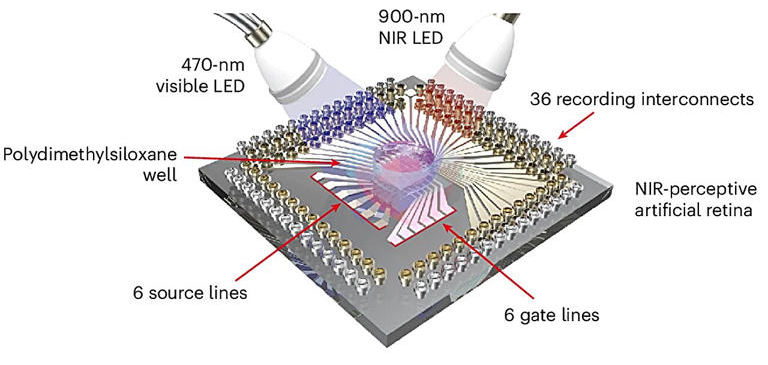
Researchers in South Korea have developed a near‑infrared–sensitive artificial retina that can partially restore vision in cases of photoreceptor degeneration—and potentially create an entirely new “infrared vision channel.”
Key Points
1. Why this matters
Many forms of blindness come from photoreceptor cell degeneration.
Retinal ganglion cells often remain functional even when photoreceptors fail.
This device bypasses damaged photoreceptors and stimulates ganglion cells directly.
2. What the artificial retina is
A thin, epiretinal implant combining:
NIR‑sensitive phototransistor array — detects near‑infrared light and converts it to electrical signals.
Liquid metal micropillar electrodes — soft, conductive pillars that deliver signals to ganglion cells while minimizing tissue damage.
3. How it works
Detects near‑infrared light (not normally visible to humans).
Converts NIR into electrical stimuli.
Stimulates retinal ganglion cells, which can still send signals to the brain.
Could allow both restoration of lost vision and perception of a new light spectrum.
4. Evidence from experiments
Ex vivo tests: No harmful effects on extracted retinal tissue.
In vivo tests on blind mice:
Behavioral changes and brain activity indicated restored light perception.
Mice responded to both visible and NIR light.
Device showed good biocompatibility.
5. Future potential
Human trials are still far off; results are preliminary.
If successful, the implant could:
Restore partial sight to people with photoreceptor degeneration.
Add a new sensory channel—perception of infrared light—without interfering with remaining natural vision.
The subjective experience of “infrared vision” is unknown and could be unlike any natural human perception.

6. Research source
Published in Nature Electronics (2026) by Won Gi Chung, Inhea Jeong, and colleagues.
Spring

Spring

Spring

Spring
Spring
Summer

Summer
Summer

Summer

Summer

Autumn

Autumn

Autumn

Autumn

Autumn

Winter

Winter

Winter

Winter

Winter
|
 Prev Prev |
September 2026 | Next |
| |||||||||||||||||||||||||||||||||||||||
Subscribe to Veegers Musings to receive new blog and comment notices plus the latest news and events.
| Categories: 10 | Subscribers: 9 |
| Blogs: 27 | Blog Reads: 1,352 |
| Comments: 16 | Most Cmnts: Veeger (5) |
04-24-2026, 17:02
Comments:
0

01-20-2025, 07:05
Comments:
0

01-19-2025, 07:25
Comments:
0

01-19-2025, 07:19
Comments:
0

01-17-2025, 08:28
Comments:
0
Veeger
on Dark Matter Detector
05-20-2026, 16:50
Fred
on Dark Matter Detector
05-20-2026, 15:50
Cheryl
on Undo Button for Cancer Cells
04-29-2025, 04:02
Cheryl
on Create Antimatter from Light
04-29-2025, 03:10
Veeger
on Grand Vision
02-14-2025, 10:02