
September 02, 2026 @
Accuracy is to a newspaper what virtue is to a lady, but a newspaper can always print a retraction.
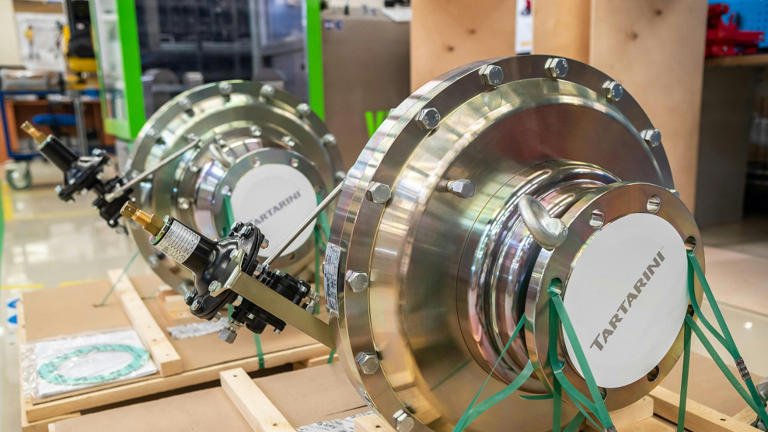
SuperCDMS Detector
Key Takeaways
- The SuperCDMS dark‑matter detector, located 2 km underground in a Sudbury, Ontario mine, has been cooled to 5.3 millikelvin—about 500× colder than the cosmic microwave background.
- This temperature is essential for detecting the tiny energy deposits expected from low‑mass dark matter particles.
- Dark matter makes up ~27% of the universe, yet has never been directly detected.
- SuperCDMS targets lightweight WIMPs (below ~10 proton masses), a mass range where large xenon detectors lose sensitivity.
- At millikelvin temperatures, even tens of electronvolts of energy can be detected as phonons and freed electrons in germanium/silicon crystals.
- SNOLAB’s 2 km of rock reduces cosmic ray muons by a factor of ~50 million, creating one of the quietest environments on Earth for particle physics.
- The C.U.T.E facility at SNOLAB has validated that millikelvin temperatures can be maintained underground.
- Magnetic fields can interfere with SQUID readout electronics; shielding is essential.
- Radon‑reduced air and layered shielding are used to suppress radioactive backgrounds.
- Without these protections, the detector would be overwhelmed by noise.
- Confirmed: The dilution refrigerator can reach 5.3 mK (tested at Fermilab).
- Not yet confirmed: Whether the same temperature has been achieved after installation underground.
- Not yet published: Real background rates or calibration spectra from the final detector configuration.
- Timeline unclear: No official date for when full physics data‑taking will begin.
- Xenon detectors (LZ, XENONnT) dominate the search for heavy WIMPs.
- SuperCDMS and DAMIC‑M explore the low‑mass WIMP region with different technologies.
- Overlapping experiments are essential for confirming any potential signal.
- If no dark matter is detected, SuperCDMS will still tighten exclusion limits and help rule out large regions of parameter space.
- The experiment’s sensitivity makes it one of the few capable of probing very light dark‑matter candidates.
Copied From: MSN.COM

05-20-2026, 16:50
Thanks for commenting buddy. Doesn't seem to be much activity on any of my blogs lately. Guess most people are too busy fiddling with AI.

05-20-2026, 15:50
Good to see you're back to posting some articles on this blog application. I got the email notification in case you're wondering.

Spring

Spring

Spring

Spring

Spring

Summer

Summer

Summer

Summer

Summer

Autumn

Autumn

Autumn

Autumn

Autumn

Winter

Winter

Winter

Winter

Winter
|
 Prev Prev |
September 2026 | Next |
| |||||||||||||||||||||||||||||||||||||||
Subscribe to Veegers Musings to receive new blog and comment notices plus the latest news and events.
| Categories: 10 | Subscribers: 9 |
| Blogs: 27 | Blog Reads: 1,265 |
| Comments: 16 | Most Cmnts: Veeger (5) |
04-24-2026, 17:02
Comments:
0

05-21-2026, 12:43
Comments:
0

01-26-2025, 06:06
Comments:
0
01-25-2025, 08:39
Comments:
0

01-21-2025, 05:08
Comments:
0
Veeger
on Dark Matter Detector
05-20-2026, 16:50
Fred
on Dark Matter Detector
05-20-2026, 15:50
Cheryl
on Undo Button for Cancer Cells
04-29-2025, 04:02
Cheryl
on Create Antimatter from Light
04-29-2025, 03:10
Veeger
on Grand Vision
02-14-2025, 10:02