
October 18, 2026 @
A rumor without a leg to stand on will get around some other way.
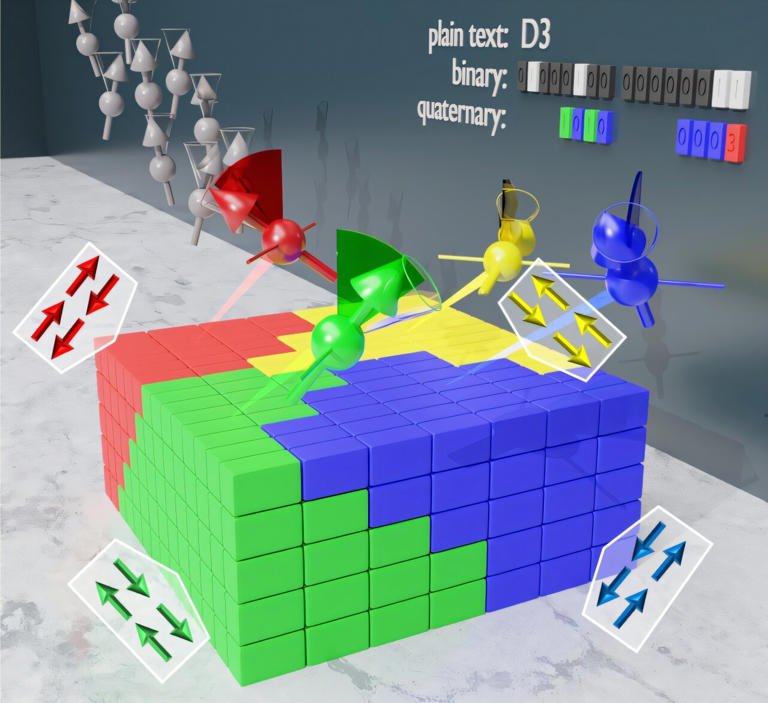
Main Points: Four‑State Magnetic Memory Breakthrough
1. A new material can store four magnetic states, not just 0 and 1
Researchers studied a crystal called LiNi₀.8Fe₀.2PO₄, which can stabilize four distinct antiferromagnetic configurations. Each configuration represents a different magnetic state—meaning a single memory unit could encode four values instead of two.
2. Why this matters: Beyond binary
Modern computing relies on binary (0/1). As devices shrink toward physical limits, packing more information per unit becomes difficult. A quaternary (four‑state) system could double information density compared to binary.
3. How the states are controlled
The material is magnetoelectric and ferrotoroidic, meaning: - Electric fields and magnetic fields together can switch it between states. - Once set, each state is non‑volatile—it remains stable without power.
4. Neutron scattering reveals the internal magnetic patterns
Using spherical neutron polarimetry at the Institut Laue‑Langevin, scientists directly observed how neutron spins changed when interacting with each magnetic state. This confirmed the existence and stability of all four configurations.
5. Antiferromagnets offer major advantages
Because opposing spins cancel out: - They produce no external magnetic field, reducing interference. - They can switch states extremely fast, ideal for future ultrafast memory. - They allow denser device packing.
6. Current limitation: Very low operating temperatures
The four‑state behavior appears below –200 °C, so this is a proof‑of‑concept, not a ready‑to‑use technology.
7. Big-picture implication
This research shows that multi‑state magnetic memory is physically achievable. If similar materials can operate at higher temperatures, they could lead to: - Higher‑density memory - Faster, more energy‑efficient spintronic devices - A shift away from binary logic in some applications
Source:
Copied From MSN.COM

Spring

Spring

Spring

Spring

Spring

Summer

Summer

Summer

Summer

Summer

Autumn

Autumn

Autumn

Autumn

Autumn

Winter

Winter

Winter

Winter

Winter
|
 Prev Prev |
October 2026 | Next |
| ||||||||||||||||||||||||||||||||||||||||||
Subscribe to Veegers Musings to receive new blog and comment notices plus the latest news and events.
| Categories: 10 | Subscribers: 9 |
| Blogs: 27 | Blog Reads: 1,466 |
| Comments: 16 | Most Cmnts: Veeger (5) |

01-16-2025, 12:29
Comments:
1
04-24-2026, 17:02
Comments:
0

01-19-2025, 07:19
Comments:
0

01-17-2025, 08:28
Comments:
0

01-14-2025, 06:19
Comments:
0
Veeger
on Dark Matter Detector
05-20-2026, 16:50
Fred
on Dark Matter Detector
05-20-2026, 15:50
Cheryl
on Undo Button for Cancer Cells
04-29-2025, 04:02
Cheryl
on Create Antimatter from Light
04-29-2025, 03:10
Veeger
on Grand Vision
02-14-2025, 10:02